It was a much larger peninsula, filled with green fields and numerous trees. Visitors often expressed their awe at its beauty, saying, “This must be the land of the gods.”
Despite the mention of gods by visitors, this peninsula was not located in Greece. Instead, the stunning and expansive peninsula, surrounded by cliffs overlooking the Pacific Ocean, was situated in a highly desirable area of Southern California.
The large peninsula boasted another popular attraction—one that was intriguingly connected to the land where Maria was born and had now returned. To explore this attraction, visitors had to climb down steep cliffs, as it was not situated on the peninsula itself, but rather adjacent to it.
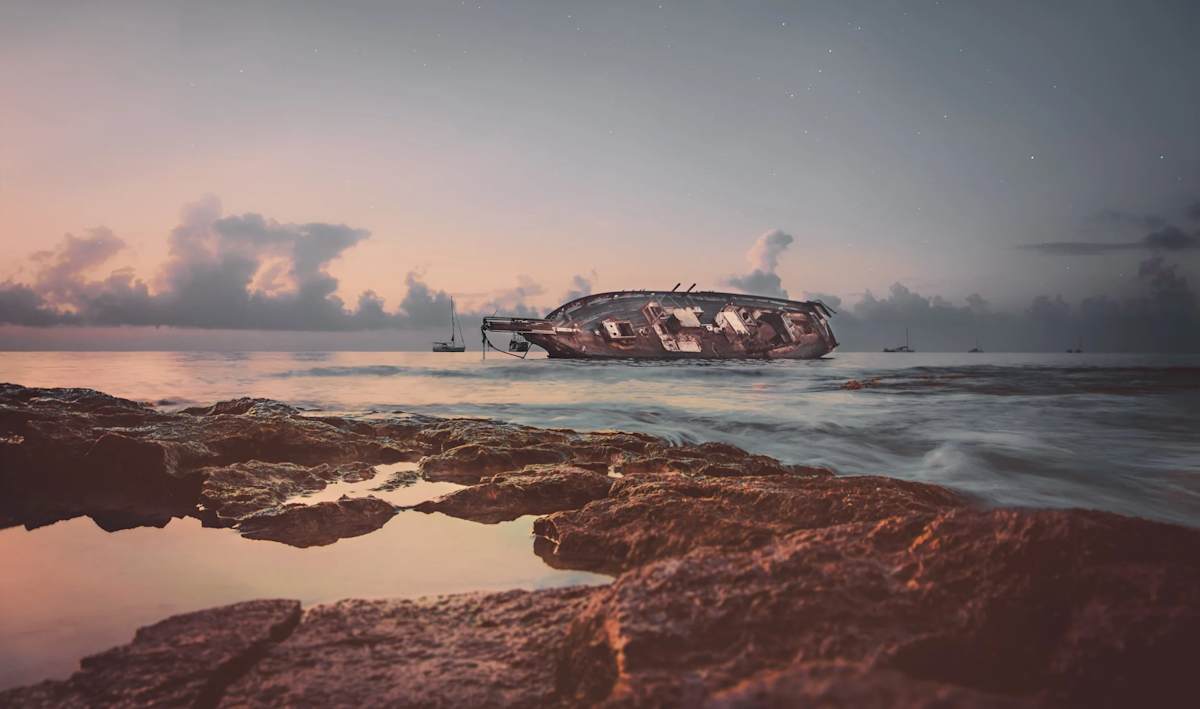
At the bottom of the cliffs, the waters of the rough bay were littered with sharp rocks and boulders. Decades earlier, a large vessel had crashed into its rocky coast on the west side.
All these years later, the rusty remains of the ship still lay impaled on those sharp rocks, waiting for adventurers brave enough to climb down and examine them.
The 441-foot vessel, a large ship for its time, was originally constructed in the early 1900s for the War Shipping Administration. After World War II, it was sold for commercial service and named The SS Victoria. In 1950, it was sold once more and renamed The SS North Queen.
Three years later, in 1953, the ship was sold to a Greek shipping company, receiving its final name—The SS Dominator.
On March 13,1961, The SS Dominator was en route to Los Angeles from Vancouver when it encountered heavy fog. Captain Papanicolaou was unable to see the lighthouse’s flashing signal at the edge of the peninsula, which resulted in the ship crashing onto the rocky coast.
Despite the efforts of the Coast Guard and tugboats to refloat the vessel, over the next two days, rough seas and high winds continued to push the ship further onto the sharp rocks. By the third day, the crew had lost all hope and abandoned ship—leaving it at the mercy of nature's powerful forces.
The location where the ship crashed was known as Rocky Point, which was also the name of the neighborhood situated directly above it, as well as the road that encircled the neighborhood.
The signs marking these places served as a constant reminder of the rugged terrain below and its storied past.
Interestingly, this same name also linked the site to ancient Greece—specifically to its rich history and mythology.
Thousands of years before and thousands of miles away, Zeus, the god of sky and thunder—also known as The Dominator—sat on his throne atop Mount Olympus. His throne located at the highest point of the mountain, known as Mytikas (Rocky Point).
It was from this lofty perch that Zeus convened with the other eleven Olympian gods, to observe the mortals below and discuss their plans.
Excerpt From
ARTEMIS CHILD: Maria’s Journey
Diane Ioannou
This material may be protected by copyright.
Author’s website: https://dianeioannou.com
August 1, 2026
The Dominator